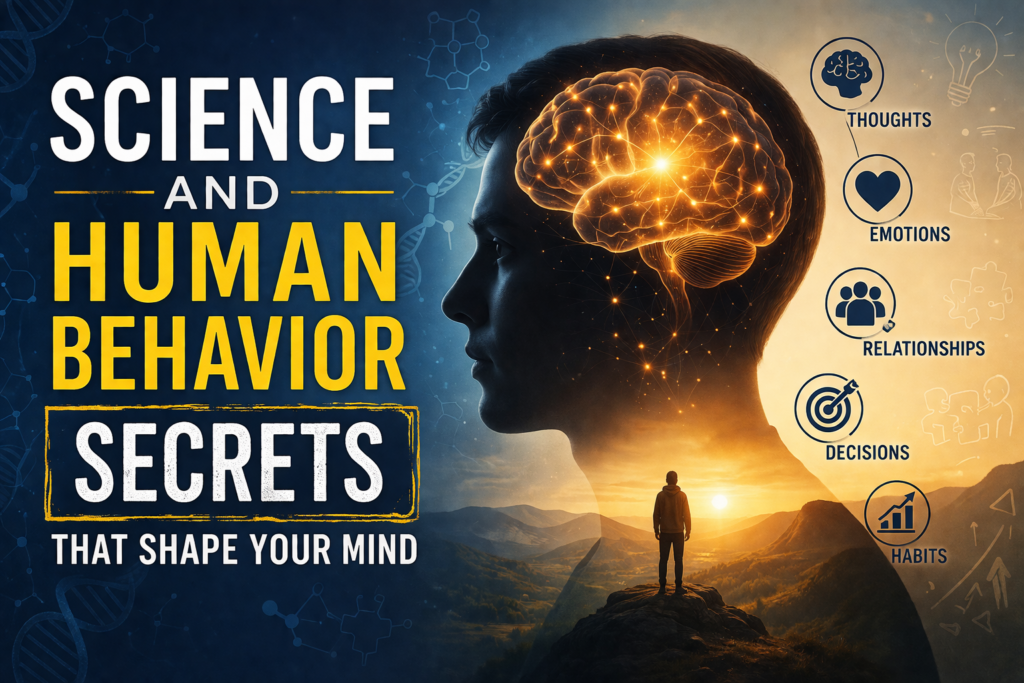

Human life feels complex, yet patterns shape our actions every day. When we explore science and human behavior, we begin to see those patterns with clarity. Science does not only explain nature; it also explains us. It reveals why we form habits, how emotions guide decisions, and what drives social interaction. As a result, we gain tools to improve our lives.
In this blog, we will explore science and human behavior in a clear and engaging way. We will connect research with real life examples, while keeping the language simple and direct. At the same time, we will focus on practical insights that you can apply daily.
Table of Contents
ToggleWhat Is Science and Human Behavior
Science and human behavior refers to the systematic study of how people think, feel, and act. Researchers use observation, experiments, and data to understand behavior. They look at the brain, environment, and social factors. Because of this, they can explain both individual and group actions.
For example, psychology studies mental processes, while neuroscience focuses on brain activity. Sociology examines group behavior, and biology looks at genetic influences. Together, these fields form the foundation of science and human behavior.
Moreover, this field does not stay limited to labs. It influences education, business, health care, and even technology. Therefore, understanding science and human behavior helps us navigate modern life more effectively.
The Role of the Brain in Behavior
The brain acts as the control center of all human actions. Every thought, emotion, and decision starts here. When scientists study science and human behavior, they often begin with the brain.
Neurons send signals across different regions. These signals control memory, emotion, and movement. For instance, the prefrontal cortex helps with decision making. Meanwhile, the amygdala processes emotions like fear and pleasure.
Because of these systems, we respond quickly to situations. However, not all responses are rational. Sometimes, emotions override logic. This explains why people make impulsive choices.
In addition, brain chemistry plays a major role. Dopamine influences motivation and reward. Serotonin affects mood. As a result, small chemical changes can shape behavior in powerful ways.
How Environment Shapes Behavior
While biology matters, environment also plays a strong role. Science and human behavior shows that people adapt based on surroundings. Family, culture, and experiences all influence actions.
For example, children learn by observing adults. If they see kindness, they often act kindly. If they see aggression, they may copy it. This process is known as social learning.
Furthermore, culture shapes beliefs and values. What feels normal in one society may feel strange in another. Therefore, behavior cannot be understood without context.
In addition, stress and environment affect mental health. A supportive environment promotes growth. On the other hand, a negative environment can lead to anxiety or harmful habits. Because of this, improving surroundings can improve behavior.
The Science of Habits
Habits form a major part of daily life. Science and human behavior explains how habits develop and how they can change.
A habit follows a simple loop: cue, routine, and reward. First, a trigger appears. Next, the person performs an action. Finally, the brain receives a reward. Over time, this loop becomes automatic.
For instance, checking your phone after a notification becomes a habit. The sound acts as a cue. The action is checking the phone. The reward is new information or social connection.
Moreover, habits save mental energy. The brain prefers routines because they require less effort. However, this also makes bad habits hard to break.
To change a habit, you must replace the routine while keeping the same cue and reward. This approach aligns with science and human behavior and leads to lasting change.
Emotions and Decision Making
Many people believe they make logical decisions. However, science and human behavior reveals a different truth. Emotions play a central role in every choice.
For example, fear can prevent risk taking. Happiness can encourage exploration. Even small emotions influence daily decisions, such as what to eat or how to respond to others.
Additionally, cognitive biases affect thinking. These are mental shortcuts that help us process information quickly. However, they can also lead to errors.
One common bias is confirmation bias. People tend to seek information that supports their beliefs. As a result, they ignore opposing views.
Understanding these patterns helps improve decision making. When you recognize emotional influence, you can pause and think more clearly. Therefore, science and human behavior offers tools for better choices.
Social Behavior and Human Connection
Humans are social beings. Science and human behavior shows that connection is essential for survival and well being.
People form relationships based on trust, empathy, and shared experiences. Communication plays a key role in this process. Both verbal and non verbal signals shape interactions.
For example, body language can reveal emotions without words. A smile signals friendliness, while crossed arms may show discomfort.
Furthermore, group behavior influences individual actions. People often follow social norms to fit in. This can lead to positive outcomes, such as cooperation. However, it can also lead to negative behaviors, such as peer pressure.
Because of this, understanding social dynamics helps build stronger relationships. It also helps individuals maintain independence in group settings.
Motivation and Goal Setting
Motivation drives action. Science and human behavior explains why people pursue goals and how they stay committed.
There are two main types of motivation: intrinsic and extrinsic. Intrinsic motivation comes from within. People act because they enjoy the activity. Extrinsic motivation comes from external rewards, such as money or recognition.
Research shows that intrinsic motivation often leads to better long term results. People stay engaged when they find meaning in their actions.
Moreover, clear goals improve performance. When goals are specific and achievable, people feel more confident. Progress creates a sense of reward, which reinforces behavior.
Therefore, applying science and human behavior can improve productivity and personal growth.
The Impact of Technology on Behavior
Technology has changed human behavior in many ways. Science and human behavior helps us understand these changes.
For instance, social media affects attention and communication. People receive constant updates, which can reduce focus. At the same time, online platforms create new ways to connect.
Additionally, technology influences habits. Many apps are designed to keep users engaged. Notifications, rewards, and endless content create strong habit loops.
However, awareness can reduce negative effects. By setting limits and using technology mindfully, people can regain control. This approach aligns with science and human behavior principles.
Mental Health and Behavior
Mental health plays a crucial role in behavior. Science and human behavior highlights the connection between thoughts, emotions, and actions.
Conditions such as anxiety and depression affect how people perceive the world. They can change decision making, motivation, and social interaction.
For example, anxiety may lead to avoidance behavior. Depression may reduce energy and interest in activities.
However, treatment and support can improve outcomes. Therapy, medication, and lifestyle changes all contribute to recovery.
Moreover, simple practices such as exercise, sleep, and mindfulness can support mental health. These habits align with science and human behavior and promote balance.
Applying Science and Human Behavior in Daily Life
Understanding science and human behavior is not just theoretical. It has practical benefits that can improve everyday life.
First, it helps build better habits. By understanding habit loops, you can replace harmful routines with positive ones.
Second, it improves relationships. When you understand emotions and social cues, communication becomes more effective.
Third, it enhances decision making. Recognizing biases and emotional influence leads to better choices.
Fourth, it supports personal growth. Clear goals and motivation strategies increase success.
Finally, it promotes well being. Awareness of mental health and environment leads to a healthier lifestyle.
Because of these benefits, learning about science and human behavior is valuable for everyone.
Future Directions in Behavioral Science
The field of science and human behavior continues to evolve. New research explores areas such as artificial intelligence, genetics, and brain imaging.
For example, scientists now study how genes interact with environment to shape behavior. This approach provides a deeper understanding of human nature.
Additionally, technology allows more precise brain studies. Researchers can observe brain activity in real time. This leads to new insights into decision making and emotion.
Furthermore, behavioral science plays a role in public policy. Governments use insights to design better systems in health, education, and economics.
As a result, science and human behavior will continue to shape the future.
Conclusion
Science and human behavior offers a powerful lens to understand life. It explains why we act the way we do and how we can change. By combining biology, psychology, and social science, it reveals patterns that guide human actions.
Moreover, this knowledge is practical. It helps improve habits, relationships, and mental health. It also supports better decision making and personal growth.
As you apply these insights, you gain more control over your actions. You become more aware of your thoughts and emotions. In turn, you can create a more balanced and meaningful life.
Ultimately, science and human behavior is not just a field of study. It is a guide to understanding yourself and others in a deeper way.

Mayank
Mayank writes thoughtful articles for BeChildAgain on emotional growth, childhood memories, overthinking, and self-reflection. His writing is simple, calm, and reader-friendly, with a focus on helping people understand their emotions without feeling judged or overwhelmed.
View all posts