
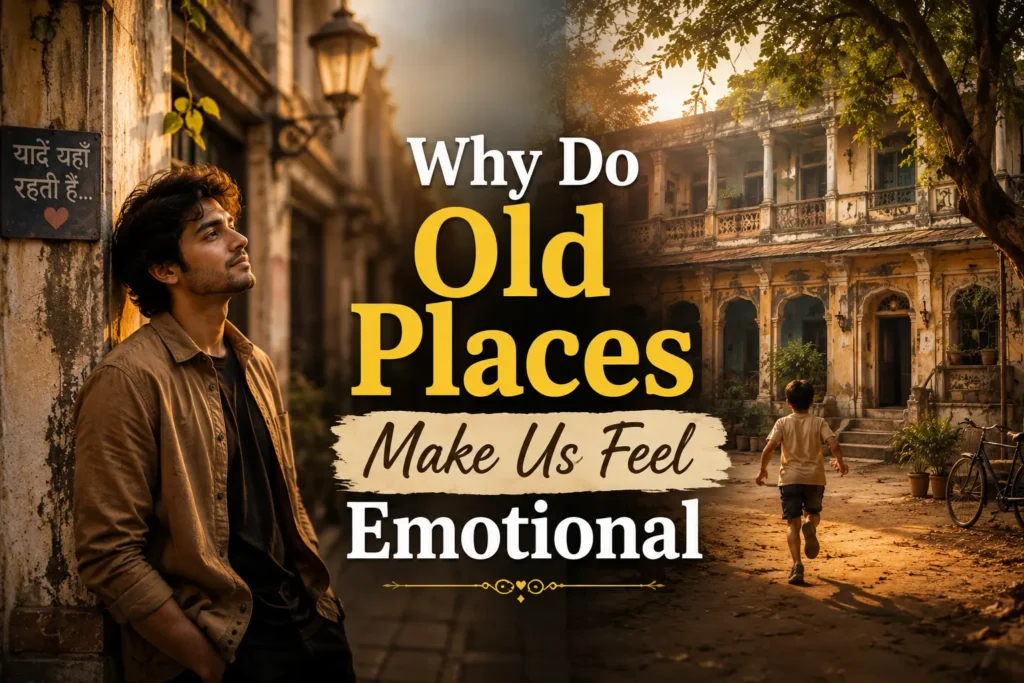

Why Do Old Places Make Us Feel Emotional?
Have you ever returned to a place you used to know well and felt something change inside you?
Maybe it was your old school, a childhood home, a neighborhood street, a small shop, or a park where you spent countless afternoons.
At first, it may look completely ordinary.
Then you notice a familiar corner.
A staircase.
An old tree.
A building that somehow looks smaller than you remember.
And suddenly, memories start coming back.
You remember people you have not spoken to in years. You remember conversations, ordinary afternoons, family moments, friendships, and parts of yourself that seem very far away now.
But why does this happen?
Why do old places make us feel emotional?
The answer is not simply nostalgia. Places can become deeply connected to our experiences, relationships, routines, and sense of identity. When we return to them, we are not only seeing a physical location. We are remembering the life we once had there.
Places Can Hold More Than Memories
A place is more than walls, roads, buildings, and furniture.
Over time, we attach experiences to the spaces around us.
Your childhood bedroom may remind you of family life.
Your school may remind you of friendships.
A particular street may remind you of walking home every afternoon.
A neighborhood shop may remind you of someone who used to visit it with you.
The location itself may not be important to anyone else.
But it can be incredibly important to you.
That is because personal memories give ordinary places meaning.
This is why walking through an old neighborhood can sometimes feel surprisingly emotional. You are seeing the same physical environment, but you are also comparing it with the version that exists in your memory.
Why Old Places Can Bring Back the Past
When you return to a familiar place, small details can trigger memories.
The shape of a doorway.
The sound of traffic.
An old sign.
A familiar building.
The layout of a room.
Even the way sunlight falls across a particular street can remind you of another time.
You may suddenly remember something you had not thought about for years.
It could be a major event, but often it is something much smaller.
You remember waiting for a friend.
You remember buying something after school.
You remember sitting with your family.
You remember taking the same route every morning.
These small details can make the past feel surprisingly close.
The Strange Feeling of Seeing Your Childhood Home Again
Few places can be as emotional as an old childhood home.
For many people, home represents more than a building.
It represents a period of life.
Perhaps you grew up there with your parents or siblings.
Maybe you celebrated birthdays there.
Maybe you spent school holidays in that house.
Maybe you had arguments, laughed with family members, played games, or simply spent ordinary evenings there.
When you return years later, the house may look different.
The walls may have been painted.
The furniture may have changed.
Someone else may live there.
The rooms may even feel smaller than you remember.
That can be strange.
You are looking at the same place, but the life you associate with it is gone.
Why Does Everything Look Smaller When We Grow Up?
Many adults experience something similar when revisiting places from childhood.
A playground that once seemed enormous suddenly looks tiny.
A classroom that once felt spacious appears much smaller.
A staircase that seemed huge when you were young may now feel completely ordinary.
Part of this comes from physical growth and changing perspective.
But there is also an emotional reason.
When we were children, our world was often smaller.
Certain places occupied a much larger part of our daily lives.
The school, home, neighborhood, and nearby park could feel like the center of everything.
As adults, our world expands.
We travel farther.
We meet more people.
We have more responsibilities.
The places that once felt enormous become smaller in comparison.
But their emotional importance does not necessarily disappear.
Old Places Can Remind Us of People
Sometimes we are not really missing the place.
We are missing the people who were there.
A particular restaurant might remind you of an old friend.
A street might remind you of someone you loved.
A park might remind you of family members who are no longer part of your everyday life.
A school corridor might remind you of people you have completely lost touch with.
This can make returning to old places bittersweet.
The physical location is still there, but the relationships surrounding it have changed.
You may stand in the same place where you once laughed with someone and realize that you have not spoken to them in years.
That realization can be powerful.
Why Familiar Places Can Feel Unfamiliar
One of the strangest experiences is returning somewhere you know very well and feeling like a stranger.
You remember how the place used to look.
You know where things were.
You remember who lived nearby.
But something feels different.
Sometimes the place really has changed.
A shop may have closed.
A building may have been replaced.
A road may look completely different.
Trees may have disappeared.
New houses may have appeared.
But sometimes the biggest change is actually within us.
We have changed since we last experienced that place.
The location may still exist, but the person who knew it then is no longer exactly the same person.
The Emotional Weight of Places That Have Changed
Change can make old places particularly emotional.
Imagine visiting your childhood neighborhood after twenty years.
The road is still there, but your favorite shop is gone.
The house next door has been renovated.
The playground has been replaced.
The old tree has disappeared.
None of these changes may seem significant to another person.
But to you, they can feel like small pieces of your personal history have disappeared.
This is one reason people sometimes feel unexpectedly sad when revisiting familiar locations.
The place reminds them that time has passed.
Sometimes We Miss the Life, Not the Location
It is easy to say, “I miss that place.”
But what we really mean may be something else.
We might miss the people who were there.
We might miss having fewer responsibilities.
We might miss our family being together.
We might miss our old friends.
We might miss the person we were at that age.
We might miss the feeling of having the future still ahead of us.
The place simply becomes a symbol of that period.
That is why an old street can create such a strong reaction even when there is nothing particularly beautiful about it.
It represents a chapter of life.
Why Ordinary Places Can Become So Important
Not every meaningful place is beautiful.
Sometimes the most emotional places are completely ordinary.
A bus stop.
A school gate.
A small grocery store.
An apartment building.
A railway station.
A quiet street.
A local playground.
At the time, we may never have thought of these places as special.
We simply went there because they were part of everyday life.
But years later, those ordinary places can become valuable because they remind us of a time when life was different.
This is one of the strange things about memory.
We do not always know which moments will become important later.
Old Places Can Remind Us How Much We Have Changed
Returning to an old place can sometimes feel like meeting your younger self.
You remember what you cared about back then.
You remember what you worried about.
You remember the people you wanted to impress.
You remember the dreams you had.
You may even remember things you once thought would matter forever.
Then you look at your life today.
Some dreams came true.
Some did not.
Some people stayed.
Others disappeared.
Some priorities remained.
Others changed completely.
The old place becomes a kind of mirror.
It shows you not only where you came from, but how much you have changed.
Why We Sometimes Want to Go Back
When people say they want to go back to an old place, they may not literally want to live there again.
They may want to experience the feeling associated with it.
Perhaps they want one more afternoon with their childhood friends.
One more family dinner.
One more carefree summer.
One more day without the responsibilities they have today.
But time does not work that way.
We cannot return to a moment exactly as it was.
Even if the building remains, the circumstances have changed.
That can be difficult to accept.
But it can also help us appreciate what those moments meant.
Nostalgia Is Not Always About Wanting the Past Back
Nostalgia is often described as simply missing the past.
But it can be more complicated than that.
You can remember a period of your life fondly while knowing that you would not necessarily want to live through it again.
Maybe childhood was wonderful in some ways but difficult in others.
Maybe your old neighborhood was familiar but not perfect.
Maybe your friendships were meaningful but eventually changed.
Remembering the good parts does not mean forgetting the difficult ones.
It simply means recognizing that the past contained moments that mattered to you.
Why Visiting Old Places Can Feel Comforting
Not every emotional reaction to an old place is sadness.
Sometimes returning somewhere familiar can be deeply comforting.
You may recognize the road immediately.
You may remember where everything used to be.
You may feel connected to your younger self.
There can be something reassuring about seeing a physical reminder of where you came from.
Modern life changes quickly.
People move.
Technology changes.
Jobs change.
Relationships change.
But an old place can sometimes provide a sense of continuity.
It reminds you that your life has a history.
What Happens When Your Favorite Place Disappears?
Perhaps one of the hardest experiences is discovering that a place you loved no longer exists.
Maybe your childhood home has been demolished.
Maybe your favorite shop has closed.
Maybe your school has been rebuilt.
Maybe a familiar playground has disappeared.
At first, it can feel surprisingly personal.
You know logically that buildings change.
Cities grow.
Businesses close.
People move on.
But emotionally, it can feel like losing a physical connection to your past.
Still, the disappearance of a place does not erase what happened there.
The memories remain part of your story.
We Carry Places Inside Us
One of the comforting things about memory is that we do not completely lose a place simply because we leave it.
We carry pieces of it.
We remember the way the street looked.
We remember where we used to sit.
We remember the people who were there.
We remember how we felt.
Sometimes our memories even create a version of the place that is different from reality.
That is okay.
Memory is not a perfect photograph.
It is part of our personal experience.
The Next Time You Visit an Old Place
If you ever return to somewhere that played an important role in your life, give yourself a moment to notice how you feel.
Do not worry if the place looks different.
Do not worry if it feels smaller.
Do not worry if you suddenly become emotional.
Those reactions are understandable.
Look around.
Notice what has changed.
Remember what has stayed the same.
Think about the people who once stood beside you.
And perhaps most importantly, remember the person you were when that place mattered most.
You do not have to go back in time to appreciate your past.
Sometimes simply standing somewhere familiar is enough to remind you how far you have come.
Some Places Never Really Leave Us
We eventually leave many places behind.
We move to different homes.
Change schools.
Find new jobs.
Make new friends.
Build new lives.
But some places remain part of us.
Not because the buildings are extraordinary.
Not because the streets are beautiful.
But because something important happened there.
We grew up there.
We laughed there.
We struggled there.
We loved there.
We learned something about ourselves there.
That is why old places can make us emotional.
We are not only looking at a location.
We are looking at a piece of our own history.
And sometimes, when we stand in a place we once knew so well, we realize something simple:
The place may have changed. We may have changed. But the memories still know the way home.


