
Why Do We Remember Embarrassing Moments for So Long?
Have you ever been lying in bed at night when your brain suddenly reminds you of something embarrassing you did ten years ago?
Maybe you said the wrong thing in front of your classmates.
Maybe you tripped while everyone was watching.
Maybe you called someone by the wrong name.
Maybe you answered a question confidently and realized you were completely wrong.
Or perhaps it was something so small that nobody else probably remembers it anymore.
Yet somehow, you do.
You can remember where you were.
You can remember who was standing nearby.
You can remember what you said.
And sometimes, just thinking about it can make you feel embarrassed all over again.
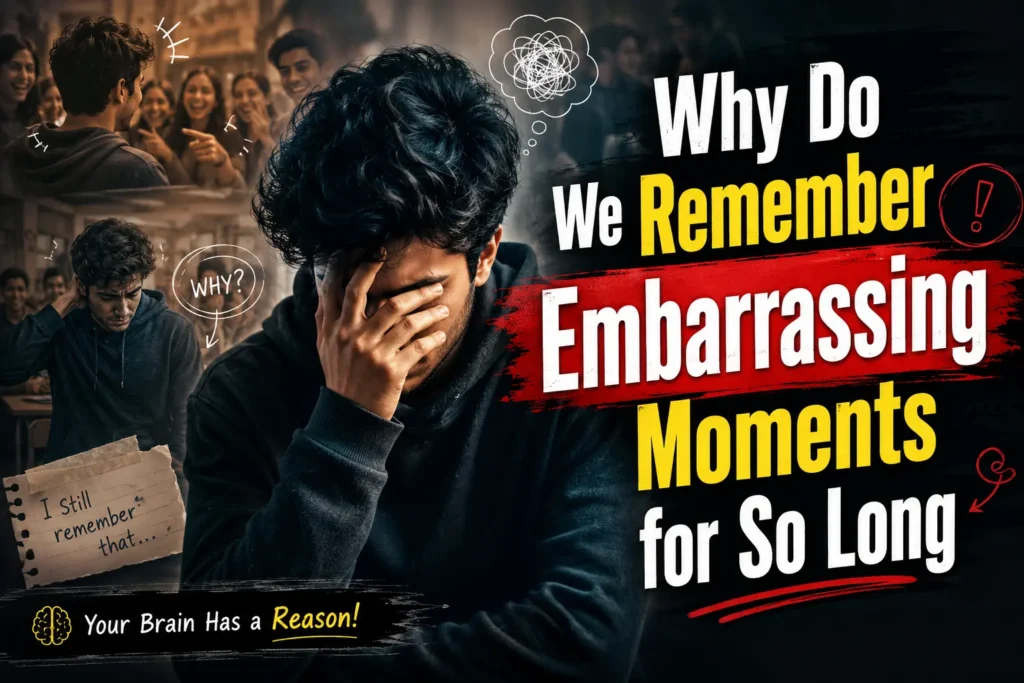
So, why do we remember embarrassing moments for so long?
It is a strange part of being human. Our minds do not store every ordinary moment with the same emotional weight. Experiences that make us feel particularly self-conscious, surprised, or emotionally exposed can become unusually memorable.
And sometimes, the memory stays with us long after everyone else has forgotten it.
Why Does Your Brain Keep Bringing It Back?
Most of us have experienced the sudden return of an old embarrassing memory.
It can happen while taking a shower.
While driving.
While trying to fall asleep.
Or in the middle of doing something completely unrelated.
You are not intentionally thinking about the past.
Then suddenly your brain says:
“Remember that thing you did in school?”
And there it is.
The memory appears almost like an unwanted notification.
You may immediately wish you could delete it.
But the fact that the memory keeps returning does not necessarily mean that it is still important to everyone else.
It may simply have been emotionally significant to you when it happened.
Embarrassment Makes Us Pay Attention
One reason embarrassing experiences can stay in our minds is that they often involve strong emotions.
When something embarrassing happens, we become extremely aware of ourselves.
We notice who is watching.
We notice what we said.
We notice how people reacted.
We may replay the situation almost immediately.
“What did they think?”
“Why did I say that?”
“Did everyone notice?”
“Could I have handled it differently?”
That intense attention can make the event stand out from ordinary moments.
You probably cannot remember what you had for lunch on a random Tuesday ten years ago.
But you might remember the day you accidentally walked into the wrong classroom.
The emotional difference matters.
Childhood and School Memories Can Be Especially Strong
Many embarrassing memories come from childhood or teenage years.
School is a place where we spend a lot of time around other people.
We are learning how to communicate, make friends, handle social situations, and understand how other people see us.
That can make small mistakes feel enormous.
Maybe you gave the wrong answer in class.
Maybe you wore something that everyone suddenly thought was strange.
Maybe you fell during a school event.
Maybe you misunderstood something everyone else seemed to understand.
At that age, embarrassment can feel like the end of the world.
Years later, however, we may look back and realize how small the moment actually was.
The memory stayed.
The embarrassment did not have to.
Why Does an Old Embarrassing Moment Still Feel Real?
Sometimes you can remember an embarrassing moment from years ago and physically feel uncomfortable.
You might cringe.
You might cover your face.
You might laugh nervously.
You might wish you could somehow travel back in time and behave differently.
Why does a memory create such a strong reaction?
Because remembering an emotional event can bring back part of the feeling associated with it.
You know that the moment is over.
You know you are older.
You know you are safe.
But your emotional response may still recognize the situation.
It is almost like your mind is briefly replaying an old scene.
The Strange Part: Other People Probably Forgot
One of the most reassuring things about embarrassing memories is that other people usually do not remember them as clearly as we do.
Think about the embarrassing things your classmates did years ago.
How many can you remember?
Probably not many.
You may remember one or two particularly funny incidents, but most ordinary mistakes have disappeared from your mind.
The same is probably true for everyone else.
The person who you are convinced remembers your embarrassing moment may have forgotten it completely.
You remember it because you were the person experiencing it.
To everyone else, it may have been just another moment in their day.
Why Do We Think Everyone Was Watching?
Embarrassment often makes us feel as though all attention was focused on us.
We become extremely aware of our own behavior.
A small mistake can suddenly feel enormous.
But other people are usually much more focused on themselves than we imagine.
They have their own worries.
Their own conversations.
Their own insecurities.
Their own embarrassing memories.
This is an important thing to remember when an old mistake suddenly comes back to you.
You may have been thinking about that moment for years.
The people around you probably moved on within minutes.
Embarrassing Memories Can Teach Us Something
Not every uncomfortable memory is useless.
Sometimes an embarrassing experience teaches us how to behave differently.
Maybe you learned to think before speaking.
Maybe you learned not to make assumptions.
Maybe you became more careful in certain situations.
Maybe you learned how to apologize.
Maybe you became more understanding when someone else made a mistake.
In that sense, an embarrassing moment can become part of growing up.
The experience was uncomfortable, but it may have helped shape the person you became.
Some Embarrassing Memories Become Funny Later
Time has an interesting effect on embarrassment.
Something that felt terrible at fifteen may become hilarious at thirty.
You may eventually tell the story to your friends.
You may laugh about it with your family.
You may even wonder why you were so worried at the time.
The event has not changed.
Your perspective has.
You have gained more experience.
You understand that people make mistakes.
You know that one awkward moment rarely defines an entire person.
That distance can turn embarrassment into a funny story.
Why We Replay Conversations
Some embarrassing memories involve things we said.
Perhaps you sent a message to the wrong person.
Maybe you misunderstood someone’s comment.
Maybe you said something awkward during a conversation.
Years later, your mind may still replay the exchange.
You remember the exact words.
You imagine how the other person interpreted them.
You think about what you should have said instead.
This can happen because our minds naturally try to understand social experiences.
We want to know what went wrong.
We want to avoid making the same mistake again.
But replaying a situation does not mean you need to keep punishing yourself for it.
Learning from an experience is different from endlessly judging yourself for it.
Why Nighttime Can Bring Old Memories Back
There is something about nighttime that makes old thoughts seem louder.
During the day, our attention is divided between work, conversations, responsibilities, entertainment, and countless other things.
When everything becomes quiet, the mind has more room to wander.
That is when an old embarrassing moment can suddenly appear.
You may be trying to sleep when you remember something from ten or twenty years ago.
It can feel ridiculous.
You may even laugh at yourself.
But the mind does not always choose memories based on what is useful right now.
Sometimes it simply wanders through old experiences.
We Are Usually Harder on Ourselves
One reason embarrassing memories can remain painful is that we often judge ourselves more harshly than we judge other people.
If a friend makes an awkward mistake, you might laugh together and move on.
If you make the same mistake, you may think about it for years.
You may call yourself foolish.
You may wonder why you behaved that way.
You may assume everyone thought badly of you.
But would you speak to a friend that way?
Probably not.
Learning to give ourselves the same patience we give other people can change how old memories feel.
You Were Younger When It Happened
This is one of the most important things to remember when thinking about an old embarrassing moment.
You were not the person you are today.
You had less experience.
You were still learning how friendships worked.
You were still learning how to communicate.
You were still discovering your personality.
You did not know everything you know now.
It is easy to look back with today’s knowledge and criticize your younger self.
But that version of you was doing the best they could with the understanding they had at the time.
They were learning.
Just like you still are.
Childhood Mistakes Do Not Define You
Sometimes people carry embarrassing childhood experiences for years.
A cruel comment from a classmate may stay in their mind.
A public mistake may become part of the way they see themselves.
They may think, “I have always been awkward.”
But one moment does not create an entire personality.
One embarrassing event does not define your intelligence.
One social mistake does not define your ability to connect with people.
One awkward conversation does not define your worth.
It was an experience.
It happened.
You learned from it.
And then life continued.
What If You Still Feel Embarrassed?
If an old memory suddenly appears, try changing the way you talk to yourself about it.
Instead of thinking:
“Why did I do that?”
You could think:
“I was younger. I made a mistake. Everyone makes mistakes.”
Instead of:
“Everyone must have thought I was ridiculous.”
Try:
“Most people probably moved on much faster than I did.”
Instead of:
“I cannot believe I behaved that way.”
Try:
“I can laugh about it now.”
You do not have to pretend the moment never happened.
You simply do not need to keep living inside it.
Sometimes an Embarrassing Memory Shows How Much You Have Grown
There is another way to look at old awkward moments.
They can show you how much you have changed.
Perhaps you are now more confident.
Perhaps you communicate better.
Perhaps you are more comfortable around other people.
Perhaps you no longer care as much about making the occasional mistake.
That is growth.
The person who made that embarrassing mistake was not a failure.
They were a younger version of you.
Without their experiences, you would not be the person you are today.
We All Have a Few Memories We Wish We Could Delete
Everyone has them.
The awkward sentence.
The strange outfit.
The wrong answer.
The accidental message.
The embarrassing fall.
The conversation that did not go the way we hoped.
We may wish our brains came with a delete button.
But perhaps there is another way to think about those memories.
They remind us that we are human.
We have all been awkward.
We have all misunderstood something.
We have all said the wrong thing.
We have all wished we could redo a moment.
That shared experience is part of being human.
The Memory May Stay, But the Meaning Can Change
You may never completely forget a particularly embarrassing experience.
And you do not have to.
What can change is what the memory means to you.
At fifteen, it might have meant:
“I am terrible at everything.”
At twenty-five, it might mean:
“That was really awkward.”
At thirty-five, it might mean:
“I cannot believe I used to worry so much about that.”
Eventually, the same memory can become a reminder of how much you have grown.
The event stays in your history.
Its power does not have to stay the same.
The Next Time Your Brain Brings It Up
So, the next time you are lying in bed and your brain suddenly reminds you of something embarrassing from years ago, take a breath.
Yes, it happened.
Yes, it was probably awkward.
And yes, you survived it.
The people who saw it have probably moved on.
You have changed.
Your life has changed.
And that younger version of you has already carried you through countless experiences to get where you are today.
You do not have to erase every embarrassing memory.
Sometimes you can simply smile at it.
Because the fact that you remember an awkward moment from years ago does not mean you are still that person.
It means you remember being that person.
And there is a difference.
We Are More Than Our Awkward Moments
Life is full of moments we wish we could redo.
But it is also full of moments we would never want to forget.
The embarrassing ones are simply part of the collection.
They remind us that growing up is messy.
We learn by making mistakes.
We become confident after feeling awkward.
We become understanding after being misunderstood.
And sometimes, the memories that make us cringe today become the stories we laugh about tomorrow.
So, why do we remember embarrassing moments for so long?
Because they mattered emotionally when they happened, and our minds tend to hold onto experiences that made us pay close attention to ourselves.
But remembering something does not mean you need to keep feeling embarrassed by it.
You were younger.
You were learning.
You made a mistake.
And then you kept going.
Maybe that is the most important part of every embarrassing memory:
You survived the moment, grew beyond it, and became someone who can look back at it now.


